Grand Cities Bird Club
  • Home
  • About Us
  • Site Guides
    • Kellys Slough
    • Oakville Township
    • Greater Prairie-Chicken Management Area
    • Greater Grand Forks Greenway >
      • North Dakota Side >
        • Riverside Dam
        • Riverside Park
        • Kennedy Bridge to Point Bridge
        • Kannowski Park
        • Lincoln Drive Park
        • Lincoln Golf Course Trail Head
        • Elmwood Access
        • Sunbeam Trail Head
        • 47th Ave S Access
      • Minnesota Side >
        • River Heights Trail Head
        • Red River State Recreation Area
        • Sorlie Bridge to Louis Murray Bridge
        • Louis Murray Bridge to Pat Owens Pedestrian Bridge
        • Red Lake River Greenway
        • East Grand Forks Sewage Lagoons
    • English Coulee Greenway >
      • Farm North of Highway 2
      • English Coulee 6th to Gateway
      • UND Campus Area
      • English Coulee South of Demers
    • Grand Forks Memorial Park Cemetery
    • Turtle River State Park
    • MN Watershed District Impoundments >
      • Parnell Water Management Area
      • Brandt and Euclid East Water Management Area
      • Brandt-Angus Water Management Area
      • Angus-Oslo Water Management Area
      • Agassiz Valley Water Management Area
      • Radium Water Management Area
      • Springbrook Stream Restoration Project
      • Nereson Impoundment
      • Ross Impoundment
      • Norland Water Management Area
  • Birding Checklists
  • Birding Month-by-Month
  • Accidental and Hypothetical Species
  • Species of Interest
    • Bald Eagle
    • Ferruginous Hawk
    • Merlin
    • Peregrine Falcon
    • Cooper's Hawk
    • Gray Partridge
    • Greater Prairie Chicken
    • Sharp-tailed Grouse
    • Yellow Rail
    • Virginia Rail
    • American Woodcock
    • Eurasian Collared-Dove
    • Pileated Woodpecker
    • Purple Martin
    • Eastern Bluebird
    • Sprague's Pipit
    • Clay-colored Sparrow
    • Baird's Sparrow
    • Le Conte's Sparrow
    • Nelson's Sparrow
    • Chestnut-collared Longspur
  • Christmas Bird Count
    • Winter Feeder Birds
  • Summer Bird Count
  • Image Gallery
  • Links
  • Contact Us
  • Email Group

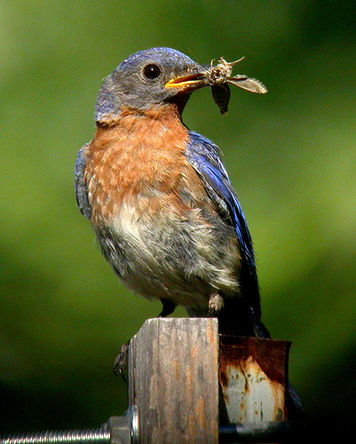
Eastern Bluebird

Eastern Bluebird
Eastern Bluebird

The Eastern Bluebird has made a dramatic comeback in the last 20 years, thanks to the setting up of bluebird trails all over North America. In the process we have learned that this is what will respond to  management practices. Not all that long ago it was rare to see one even in migration in the Grand Cities area, and there were few if any known nesting locations. This changed due to the efforts of one man, Art Schroeder, who established extensive bluebird trails in the Mekinock and Emerado areas. At times, bluebird production has exceeded 150 young/year. In addition to the expected Eastern Bluebird, Mountain Bluebirds regularly nest in small numbers at Icelandic State Park, and there has been a recent report of a nesting involving a Mountain Bluebird at Turtle River State  Park.

Eastern Bluebirds may have declined historically due to competition for nesting cavities by other species, especially introduced species such as Starling and House Sparrow. To maintain a successful bluebird trail requires considerable effort and knowledge of do's and don'ts. A typical experience is early success with bluebirds which peaks after a few years. Then there can be a decline in bluebirds as other species, especially Tree Swallows, House Wrens, and House Sparrows move in. To deal with Tree Swallows, place the bluebird houses in pairs spaced 5-25 feet apart. A pair of Tree Swallows will allow Eastern Bluebirds to use one box while they use the other. At the same time the nesting pair of swallows defend the area from 
incursion by a second pair of swallows. House Wrens become more of a problem when boxes are placed too close to wooded areas. House Sparrow infestation will decrease as the boxes are placed further from human habitation. Then there are problems with various predators. To learn more about bluebirds, visit http://www.nabluebirdsociety.org

The Greater Grand Forks Greenway will provide extensive, excellent habitat for Eastern Bluebirds. The establishment of a trail would make a wonderful project for someone so inclined.
 

Back to List
Next


Home
| About | Contact Us | Site Guides | Checklists | Month-by-Month | Species of Interest | CBC | Image Gallery | Links
Grand Cities Bird Club - 2011 - All Rights Reserved

Powered by Create your own unique website with customizable templates.