Grand Forks Memorial Park Cemetery
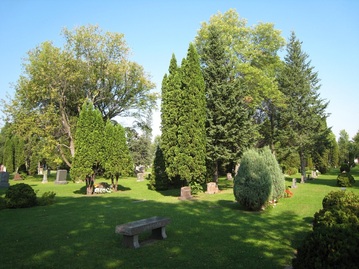
Diversity of Trees in the Cemetery
Access:
The northwest corner of the cemetery is adjacent to the intersection of US 2 (Gateway Drive) and Columbia Road. From this intersection, proceed south on Columbia Road and turn left (east) on 10th Ave N. You can make an immediate left into Calvary Cemetery or continue east to the next left which will be into Memorial Park Cemetery. (See on Map.)
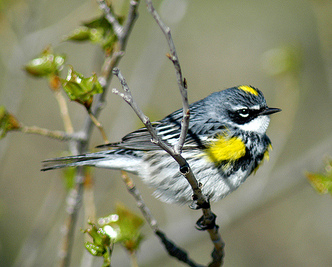
Yellow-rumped Warbler
The cemetery was established on native prairie in about 1881. Birding is good here because of the wide variety of mature trees and shrubs, the mix of conifers and deciduous trees. Some of the elms and cottonwoods are likely more than a hundred years old.
One way to bird the cemetery is to slowly drive the available roads. Otherwise, pull over to the side of one of the roads and park. Be sure not to park on the grass. One of the best ways to find birds is to look and listen for chickadees and nuthatches. In fall and spring, migrants tend to be found in a mixed flock with these species. Even on a good day there may only be one such flock in the entire cemetery.
One way to bird the cemetery is to slowly drive the available roads. Otherwise, pull over to the side of one of the roads and park. Be sure not to park on the grass. One of the best ways to find birds is to look and listen for chickadees and nuthatches. In fall and spring, migrants tend to be found in a mixed flock with these species. Even on a good day there may only be one such flock in the entire cemetery.
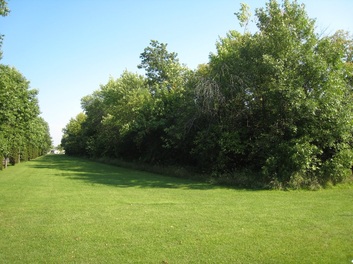
Shelterbelt along East Edge of Cemetery
Perhaps the most exciting time to bird the cemetery is during spring warbler migration when the elms are in bloom. At that time, in mid- to late-May, warblers forage for insects in debris dropped by blooming elms.
Often the best place to find birds is a shelterbelt that runs along the east side. Walk slowly along the east or west side of this shelterbelt, listening and looking for birds. Which side is better can depend on the sun angle and wind direction.
Another good area is just across the north-south road paralleling the shelterbelt where there is a particularly good mix of trees and shrubs.
Often the best place to find birds is a shelterbelt that runs along the east side. Walk slowly along the east or west side of this shelterbelt, listening and looking for birds. Which side is better can depend on the sun angle and wind direction.
Another good area is just across the north-south road paralleling the shelterbelt where there is a particularly good mix of trees and shrubs.
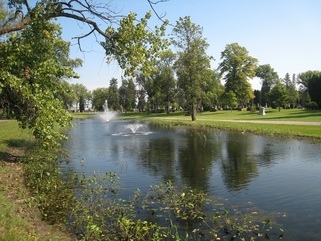
Cemetery Pond
Be sure to check the cemetery pond. The pond sort of replaces the coulee that once ran through the cemetery but has been filled in over time. At the proper time of spring and fall migrations, Solitary and Spotted Sandpipers may be found along the edge. Ducks that use this pond include Wood Duck and Mallard, which nest within the cemetery, and Blue-winged Teal. Hooded Mergansers occur occasionally in the spring. A Belted Kingfisher might be spotted in the trees overlooking the pond.
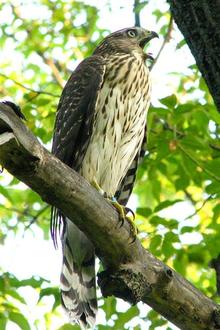
Immature Cooper's Hawk
The cemetery has been birded more consistently in all seasons than any other spot in the greater Grand Forks area. A checklist kept over the last 30+ years recently topped 200 species, yet some relatively common day migrants that surely fly over the cemetery are not on the checklist. Species that were first-state records at the time they were found include Bewick's Wren, Worm-eating Warbler, and Yellow-throated Warbler. The only Boreal Chickadee known for Grand Forks County came to a suet feeder in the cemetery.
The best time to bird the cemetery is during migration. Relatively few birds nest within the cemetery. The first pair of Cooper's Hawks known to nest in Grand Forks or East Grand Forks was here, in the late 1980s. Merlins also nest in the cemetery. In winter, the cemetery is one of the better places in Grand Forks to find finches and other species that are attracted to conifers.
The best time to bird the cemetery is during migration. Relatively few birds nest within the cemetery. The first pair of Cooper's Hawks known to nest in Grand Forks or East Grand Forks was here, in the late 1980s. Merlins also nest in the cemetery. In winter, the cemetery is one of the better places in Grand Forks to find finches and other species that are attracted to conifers.
Home | About | Contact Us | Site Guides | Checklists | Month-by-Month | Species of Interest | CBC | Image Gallery | Links
Grand Cities Bird Club - 2011 - All Rights Reserved
